
Long Beach tenants are being displaced by improper substantial remodel evictions
Advocates say city's data doesn't show complete picture of displacements.

This is The Southlander’s first originally reported story. In order to continue doing this work, we need your support. If you are not already, please consider becoming a paid subscriber.
• • •
What started as a tenant's request to fix a couple of slow-draining sinks in the kitchen and bathroom escalated into a 60-day eviction notice for Long Beach resident Mohamed Dwaik and his family last summer.
The reason for the eviction on the notice was a single word: “Renovation.”
At the time, Dwaik, a college student at Cal State Long Beach, was living with his brother and parents. The family had been in their three-bedroom, two-bathroom apartment in southeast Long Beach for over 20 years. They paid $2,100 a month in rent. Because of how long they had been living there, Dwaik says he suspected his family may have been paying less rent than their neighbors in the building.
This is a scenario that local tenant rights groups say is playing out across Long Beach: a longtime tenant complains about a habitability issue and is given a dubious eviction notice claiming they need to leave due to remodel or renovation work.
“When it was happening, it was very stressful for my parents. I was trying to, you know, convince them this isn't really right,” Dwaik said.
At one point, Dwaik’s father texted the landlord, Morteza Hajian, offering to instead pay for a plumber out of his own pocket. “I can’t leave my unit with my family and my special needs son,” he wrote, referring to Dwaik’s younger brother.
According to Dwaik, between July and October, Hajian continued sending eviction threats via text message, going back and forth between citing overcrowding and renovating as reasons for their removal.
Under California’s 2019 Tenant Protection Act, landlords are generally prohibited from evicting a tenant who has done nothing wrong, with a few exceptions known as “no-fault just causes.”
One of those exceptions is when a landlord wants to do major renovations to a property. These types of evictions are sometimes known as “renovictions.” But local tenant rights groups say some landlords in Long Beach are not playing by the rules and exploiting the so-called “renoviction loophole” to get rid of tenants who are paying below-market rents.
To evict a tenant for a substantial remodel, the work must require a tenant to vacate the residence for at least 30 consecutive days and involve major modifications to structural, electrical, plumbing, or mechanical systems. In Long Beach, there are additional requirements, which include notifying the city if tenants will be displaced by a remodel. The eviction notice must also come with either a copy of the building permits or a signed agreement with a contractor for the proposed work.

Help us unleash The Southlander! Our team of talented journalists are itching to start publishing investigative reporting. But we first need to reach our goal of $2,000 in monthly subscriptions. You can help by signing up for a paid subscription below. Subscriptions start at only $5 a month and it only takes a few seconds to upgrade.
In Dwaik’s case, the city had no record of the landlord, Morteza Hajian, having filed a notice of displacement, nor did the eviction notice left on Dwaik’s door include the required documentation.
“My parents didn't want to go to court because they were thinking, ‘Okay, we're not going to win in court, or he (Hajian) knows the system better, so they kind of settled with him. He agreed to give us $2,000 if we're out before the end of October.”
Reached by phone, Hajian denied trying to evict the Dwaik family and said Dwaik’s father chose to leave.
“We just bought the property a year ago. We asked if he would like to leave. He said, ‘Yes.’ I said, ‘I want to renovate,’ and he accepted. I helped him to move out,” Hajian said. “No, no, no, I did not evict him.”
When asked about the eviction notice left on Dwaik’s door, which was reviewed by The Southlander, Hajian said, “This is a private matter, I don’t have to talk to you.” He then hung up the phone.
Dwaik and his family ended up moving to neighboring Lakewood.
"It's definitely just gonna take some adjusting, for sure, because my brother is special needs, so there's certain programs and stuff that's location-based," he said.
Their old apartment was listed in December for $3,200 a month, an increase of $1,100 above what they had been paying.
The City of Long Beach has received notices of displacement due to substantial remodel evictions for at least 217 tenants from at least 164 units since April 2023, according to its Community Development Division.
But that is likely a severe undercount, according to local tenant rights advocates, because it doesn’t include cases in which a landlord uses renovations as a pretext for an eviction without meeting the legal requirements or notifying the city. In this gray area, the threat of eviction can be enough to prompt tenants to move out on their own, much like the case of the Dwaik family, which went unrecorded by the city.
“There are ways in which the city, I think, is not counting the full scope of the problem because a lot of landlords are just giving notices that they need to substantially remodel the building or apartment. And then some people are simply self-evicting themselves because they actually don't know that this is happening,” said Andre Donado, the executive director of Long Beach Residents Empowered, an affordable housing and tenant rights organization.

Daniel Yukelson, the CEO of the Apartment Association of Greater Los Angeles, contends the opposite is happening: “You know, if the city would just do a study, they would realize that these tenant claims are blown out of proportion on these renovictions.”
But there have been reports of landlords bending the definition of “substantial remodel” to improperly evict tenants in Long Beach going back at least five years. In 2022, the city strengthened tenant protections in an attempt to disincentivize the abuse of substantial remodeling evictions, requiring landlords to pay at least $4,500 in relocation assistance to tenants.
But advocates with the Long Beach Just Housing Coalition, which includes LiBRE, say landlords continue to exploit substantial remodel justifications to evict tenants and jack up rents beyond what is permissible while a tenant is living at a property. They claim that the city has fallen behind on measures to protect tenants.
Los Angeles banned substantial remodel evictions last year. At the time, LA had recorded renovictions at 99 units from Jan. 27, 2023, to April 9, 2025. That’s less than the number of units where tenants were displaced in Long Beach’s most recent official count of substantial remodel evictions, despite LA having eight times the number of renter households.
At least five other Southland cities prohibit substantial remodeling evictions, including Cudahy, Inglewood, Santa Monica, South Pasadena, and West Hollywood.
The Long Beach Just Housing Coalition launched a campaign last week to reform the city’s just-cause eviction ordinance on four points, including eliminating substantial remodeling evictions.
Instead of permanently evicting a tenant, the proposed changes would require a property owner to provide per-day relocation assistance when repairs or remodels require a tenant to temporarily leave their home. This could be used to pay for lodging. If a tenant must be displaced for 31 days or more, a landlord may instead provide comparable temporary accommodations.
Other changes proposed by the coalition include making just-cause eviction protections universal rather than only applying to renters after 12 months of occupancy; setting the amount of overdue rent that can be grounds for an eviction at two months’ worth; and aligning relocation assistance amounts with LA County standards, which adjust for inflation.
Yukelson warned that if Long Beach follows the footsteps of LA, it will “chase property owners out” and make housing more unaffordable.
“It's all become a big wealth transfer to renters. The renters have done a good PR job of making themselves to be the downtrodden and the underserved and the exploited. But you know, it's just not true. Owners really don't want to have to remove a tenant. They're in the housing business and not the eviction business,” Yukelson said.
He says substantial remodel evictions are necessary due to Long Beach’s aging housing stock that needs to be upgraded. According to Long Beach’s Housing Element, over 80% of housing units are more than 50 years old.
Donado agreed that aging housing needs to be brought up to code but argued that these types of evictions only serve to disincentivize tenants from reporting unsafe conditions.
“If people need to be relocated, it should be on the landlord to relocate them, to fix the building for as long as it needs to, and then to bring them back to the building and to their communities," he said.
Currently, if a Long Beach tenant suspects that the basis for a substantial remodel eviction is invalid, their only recourse is to fight it in court.
The city says it has a review process to verify whether displacements due to substantial remodel projects are justified. However, the Long Beach Community Development Department, which is in charge of these reviews, can only provide a non-binding opinion, meaning the city does not have the legal authority to step in and stop a substantial remodel it deems unlawful.
Mary Daou, an administrative analyst with the Community Development Department, explained via email that the courts have the final say in disputes about terminating a tenancy.
Landlords can face civil fines of up to $15,000 if a judge finds that they illegally evicted their tenants. But obtaining legal representation can be prohibitively expensive for renters, often resulting in a default judgment for the landlord.
Brianna Aguet, the supervising attorney at the Long Beach Eviction Defense Center, said her office had to contract with specialized outside counsel and an expert witness to win a case where a landlord was claiming that replacing kitchen cabinets was grounds for eviction.
“That is something that, definitely, a run of the mill tenant cannot do on their own,” she said.
In that case, Aguet said, the City of Long Beach issued building permits to a landlord for work that was merely cosmetic.
“Why are you issuing a permit, giving the landlord — I'm not even saying that they're doing it out of ill intent — but giving the landlord what they need in order to file an eviction, when, in fact, it was not necessary at all. But the city collected $275.92 for this permit,” Aguet said.
She said this is evidence that the city’s review process is toothless and ineffective.
Eighth District Councilmember Tunua Thrash-Ntuk echoed these concerns during a Long Beach Housing and Public Health Committee meeting on Feb. 3: “We often hear from the community that the landlord may pull a permit, and it will be for something very minor and that will trigger an eviction.” She asked city staff how the city verifies that a landlord is actually substantially remodeling.
Long Beach’s Director of Community Development Christopher Koontz responded, “That’s an area where we can always do better.”
The Southlander followed up with the Community Development Department, asking whether any changes had been made or were planned since Koontz’s remark.
“City staff regularly review internal procedures and coordination between departments to ensure that tenant protection requirements are clearly communicated and consistently applied. Staff are continuing to evaluate opportunities to strengthen internal coordination and improve how information is shared with applicants regarding tenant protection obligations associated with construction projects that may involve displacement,” Daou wrote back in an email.
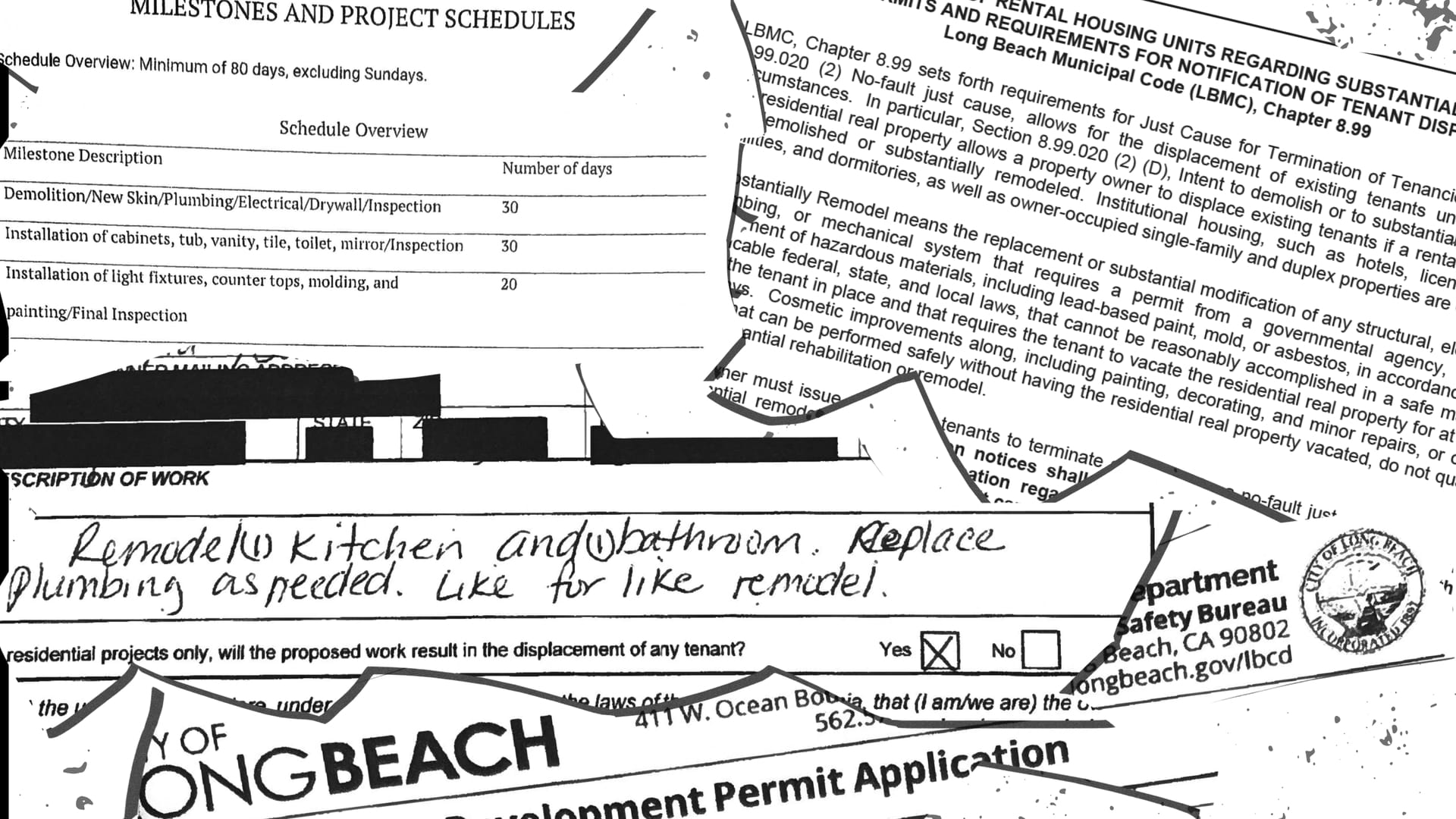
In late October, Long Beach tenant Vicky, who asked that we not use her last name for fear of retaliation from future landlords, received a 60-day eviction notice due to substantial remodeling. The notice stated that the “proposed kitchen, bathroom and new skin remodel” would take 80 days.
Vicky said substantial remodeling needs to be removed as a cause for evictions and called the current system “negligent.”

Her landlord, Julia Tapia, hired a contractor and filled out a building permit application indicating that a tenant would be displaced by the proposed work. When that box is checked, it is supposed to trigger a requirement that the property owner submit a supplemental tenant displacement form before a permit can be issued. But Tapia did not submit the supplemental form yet was still issued a permit —meaning the city did not review whether the displacement was justified.
According to Tapia, she was never informed by the city about the form and said more should be done to educate landlords about this requirement.
“I think it wasn't fair that I wasn't provided with the form,” she said. “There's no reason for me not to have completed it, like absolutely no reason. I didn't know about it.”
Daou, however, said it is ultimately up to landlords to make sure they are following the law.
After Vicky inquired with the city about the eviction notice, Daou reviewed the building permit application and sent a letter to Tapia informing her that the proposed work did not meet the definition of "substantial" and “only involves like-for-like replacement of cabinets, fixtures, flooring, and finishes… With no structural or system alterations, the project is limited to cosmetic updates.”
But by the time Daou sent the letter in November, Vicky had already found a new apartment and was planning to move out.
Vicky says she suspected that the eviction notice was issued in retaliation for her complaints about dust from previous construction work in her unit. Tapia denies that, saying the building was a fixer upper and she had always planned to overhaul it. In January, once Vicky had vacated the unit, Tapia pulled another building permit to remodel the laundry room, replace the water heater, add a new dishwasher, and do further electrical work.
“My mom came from Mexico," Tapia said. "We were renters. We grew up in Wilmington. I'm not going to disrespect renters because we've been there, you know what I mean?”
Even though she is now living elsewhere, Vicky says the experience left her feeling on edge.
“I have PTSD anytime I have to make a maintenance request or I see something that looks off,” she said. “Or what if they sell the building, am I going to be fucked in a year and have to move again?”
In March, a small claims court ordered Tapia to pay Vicky $10,489 in damages.
Editor’s note: Erin Foley, a worker-founder of The Southlander, has an employment relationship with tenant advocacy organization Long Beach Residents Empowered. She recused herself from all editorial duties related to this article.
Reporter’s View: As a longtime Long Beach renter myself, I have a deep interest in housing issues, which I have been reporting on for many years. I first got interested in substantial remodel evictions after I filed a public records request with the City of Long Beach for all of the supplemental tenant displacement forms landlords had submitted. These records showed that substantial remodel evictions made up a relatively small amount of the thousands of evictions that get filed in court every year in Long Beach. However, as I began speaking to tenant rights advocates and then tenants themselves, I learned that there is a lot of grey area where renters are self-evicting that isn’t being captured by the official city numbers. That’s what this story is about.