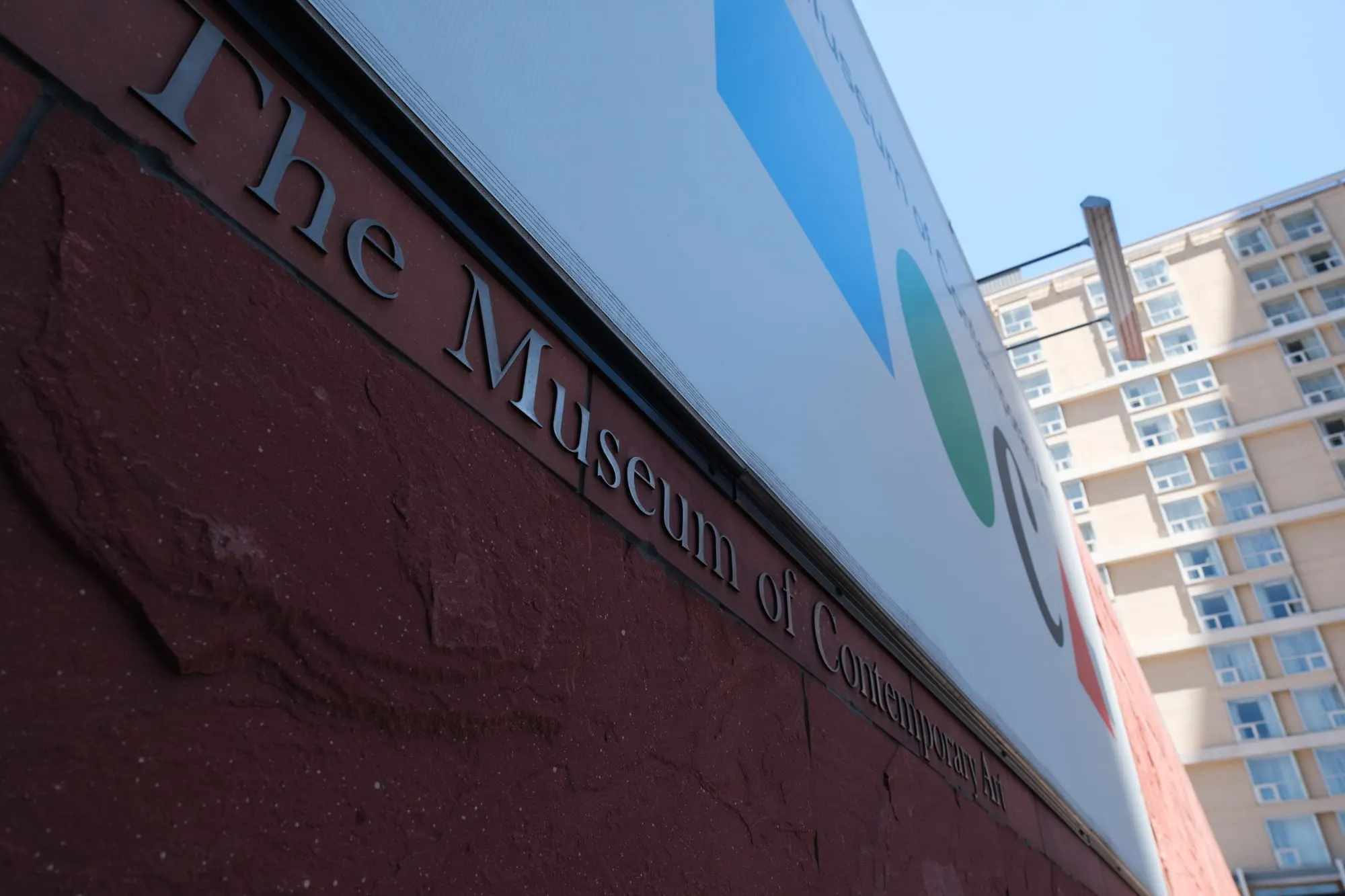

Unionized workers at the Museum of Contemporary Art (MOCA), who are among the lowest-paid museum workers in the city, escalated their push to negotiate a new contract and wage increases by staging public protests. Represented by the American Federation of State, County, and Municipal Employees (AFSCME) District Council 36, the union argues that the people who maintain one of the city’s most recognizable landmarks and cultural institutions can no longer afford to live in the city where they work.
Like many of her fellow union members, Kristen Huizar struggles to pay her bills because MOCA only offers her part-time hours, forcing her to pick up a second job.
“I’ve worked there for several years now. I love my job. I love art. I like talking to people. I love talking to people about art. One thing I don’t love about working at MOCA is that I get paid peanuts, essentially. $18.97 – not even a full $19,” Huizar said.
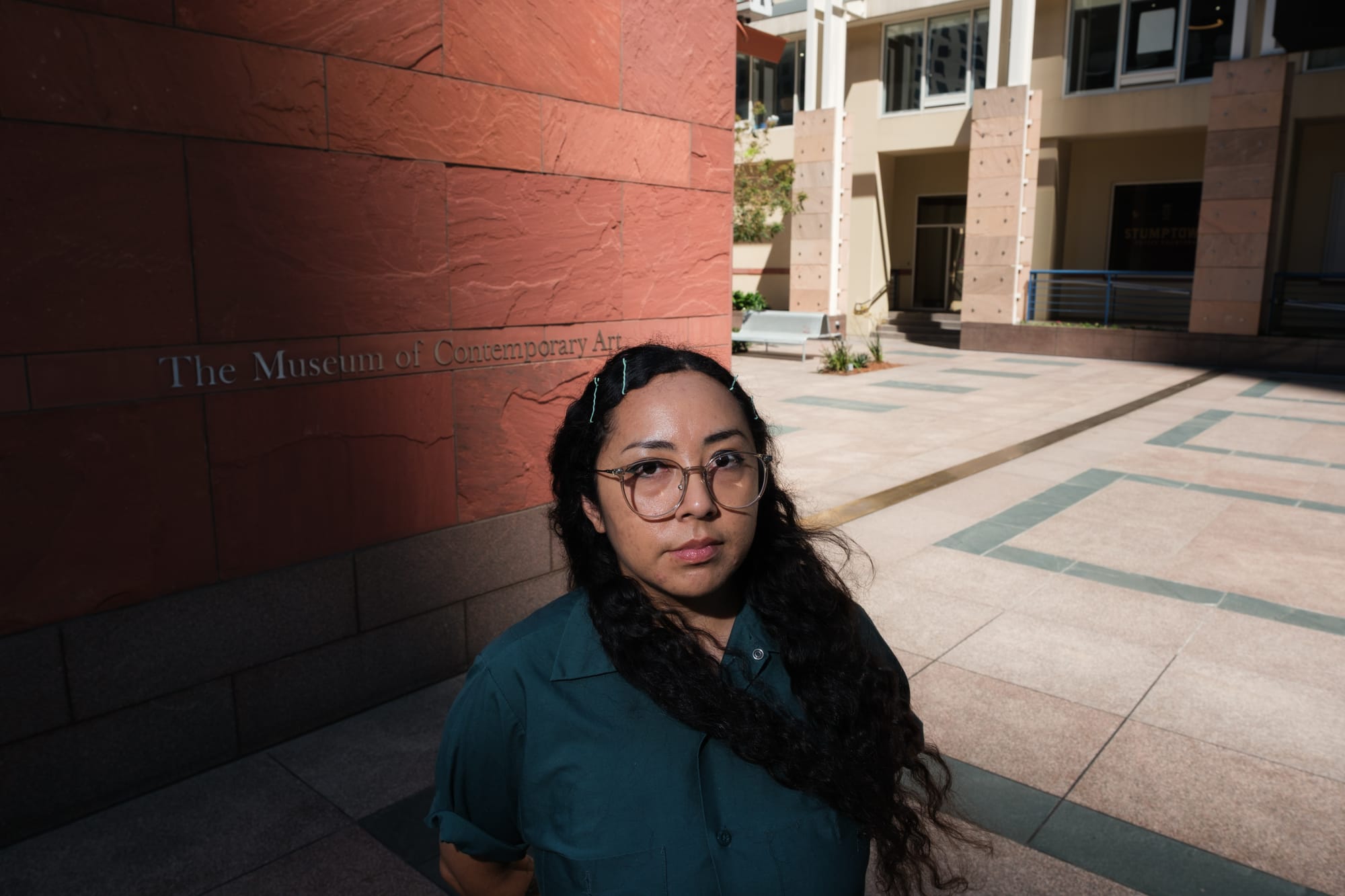
Negotiations with MOCA’s upper management have gone nowhere, according to the union’s lead negotiator, Russell Maitlaid.
“They refuse to negotiate in person. They want the workers to negotiate on their off time. In comparison, other museums allow their workers to negotiate while on paid time. And they refuse to meet with them when they are off-hours,” Maitlaid said. “The bargaining sessions we’ve been having have been virtual, and they’ve been averaging between 30 and 40 workers per session because workers are interested in negotiating their working conditions.”
According to AFSCME, the bargaining team submitted a wage proposal in late 2025 asking for hourly wage increases of $22.50 for part-time employees and $23.50 for full-time employees. A few weeks ago, the union met with MOCA leadership to discuss their wages.
“They responded to our proposal this morning and offered us a $20 starting wage, and everyone was pretty pissed,” Huizar said on May 30.
Since MOCA employees voted to unionize in 2019, the cost of living has steadily increased.

Help support The Southlander by signing up for a paid subscription below. Subscriptions start at only $5 a month and it only takes a few seconds to upgrade.
Food prices have surged by roughly 28% since 2020, according to the Bureau of Labor Statistics. Additionally, the average rent for a one-bedroom apartment in LA is $2,181 a month, according to apartments.com. Even for Angelenos living in rent-stabilized units, the Los Angeles Housing Department permits annual rent increases of up to 3%.
Because of these economic pressures, the union said it is also asking MOCA to offer more full-time slots to its workers. Maitland added that about 10-15% of their employees are full-time, and they can offer 50% of their employees to work full-time because of the workload.
As its workers struggle with the rising costs of rent, transportation, healthcare, and food, MOCA earns millions in revenue each year. In 2025, the museum made $29.6 million in revenue, according to data from ProPublica’s Nonprofit Explorer.

Starting wages for MOCA are currently $16.25 per hour. By contrast, employees at The Broad Museum across the street make from $18 to $25 per hour, and starting hourly pay at the Academy Museum of Motion Pictures is $20.
MOCA employees include educators, exhibition installers, gallery attendants, visitor engagement staff, and technicians. They are responsible for guarding and protecting the art, informing visitors about the exhibits, and maintaining public programming that keeps the museum functioning. Their contributions help draw around 300,000 visitors annually across MOCA’s two locations.
MOCA’s negotiator, Michael Harris, did not respond to repeated requests for an interview. MOCA’s Chief Communications Officer, Danielle Bias, confirmed Harris received The Southlander’s interview requests.
When the MOCA union was established in 2019, it fought for healthcare coverage for full-time workers like José Rodriguez, who works on the visitor engagement team.
“The portion that we pay as full-time workers is pretty great, and it lets us afford really nice healthcare. And for me personally, that was like, honestly, a lifesaver. I had a medical incident about two years ago,” Rodriguez said. “I had to take some time off of work. I was in the hospital for quite a while and, I think, knowing that I had health insurance that would be there for me enabled me to get help when I needed it.”
However, Rodriguez added his part-time colleagues at MOCA still struggle to pay for their healthcare.
At the time of the union’s formation, MOCA workers also cited low pay, unstable scheduling, lack of transparency from upper management, and poor working conditions as reasons for organizing. Still, many of these problems persist within the museum industry.
The struggle between AFSCME and MOCA reflects a broader labor movement, both locally and nationwide, in which workers at nonprofit museums are opting to unionize.
Since 2019, more than 50 new unions have formed at nonprofit and private art museums across the United States, according to data from Museums Moving Forward, an independent organization dedicated to creating more equitable working conditions in the museum sector.
Earlier this year, the staff of the Metropolitan Museum of Art in New York voted to unionize with UAW Local 2110. Last year in Chicago, Field Museum Workers United/AFSCME members won their first-ever union contract. In 2024, the Denver Art Museum became the first art museum in Colorado to unionize, with eligible employees voting to join AFSCME.
Unionization and worker actions have increased across all sectors of the workforce, not just the museum industry.
In the last several years, LA has witnessed its entertainment industry of over 170,000 workers, including writers (WGA) and actors (SAG-AFTRA), launch a strike that resulted in a stoppage of all film and television production. At the same time, thousands of hotel housekeepers, front desk agents, and cooks (UNITE HERE Local 11) organized walkouts and protests to demand better wages and working conditions.
Like many other local unions, MOCA workers say their motivation to obtain better wages will propel them to organize publicly until their contracts reflect the realities of living and working in LA.
Edit: MOCA responded with the following statement the day after publishing: "MOCA has been negotiating in good faith with the union and remains committed to our staff and to a positive outcome for everyone.”
Reporter's View: There is something to say about this generation’s workforce that starts with young people. I remember, in the early years of joining the legal workforce as a teenager, I worked in a variety of industries. From food service and office sales to customer service and retail — you name it — the idea of unionizing your workplace because of working conditions (pay, material conditions, schedule, etc.) was not a popular in the early 2000s. Seeing this generation unionizing to fight for better wages is inspirational.